
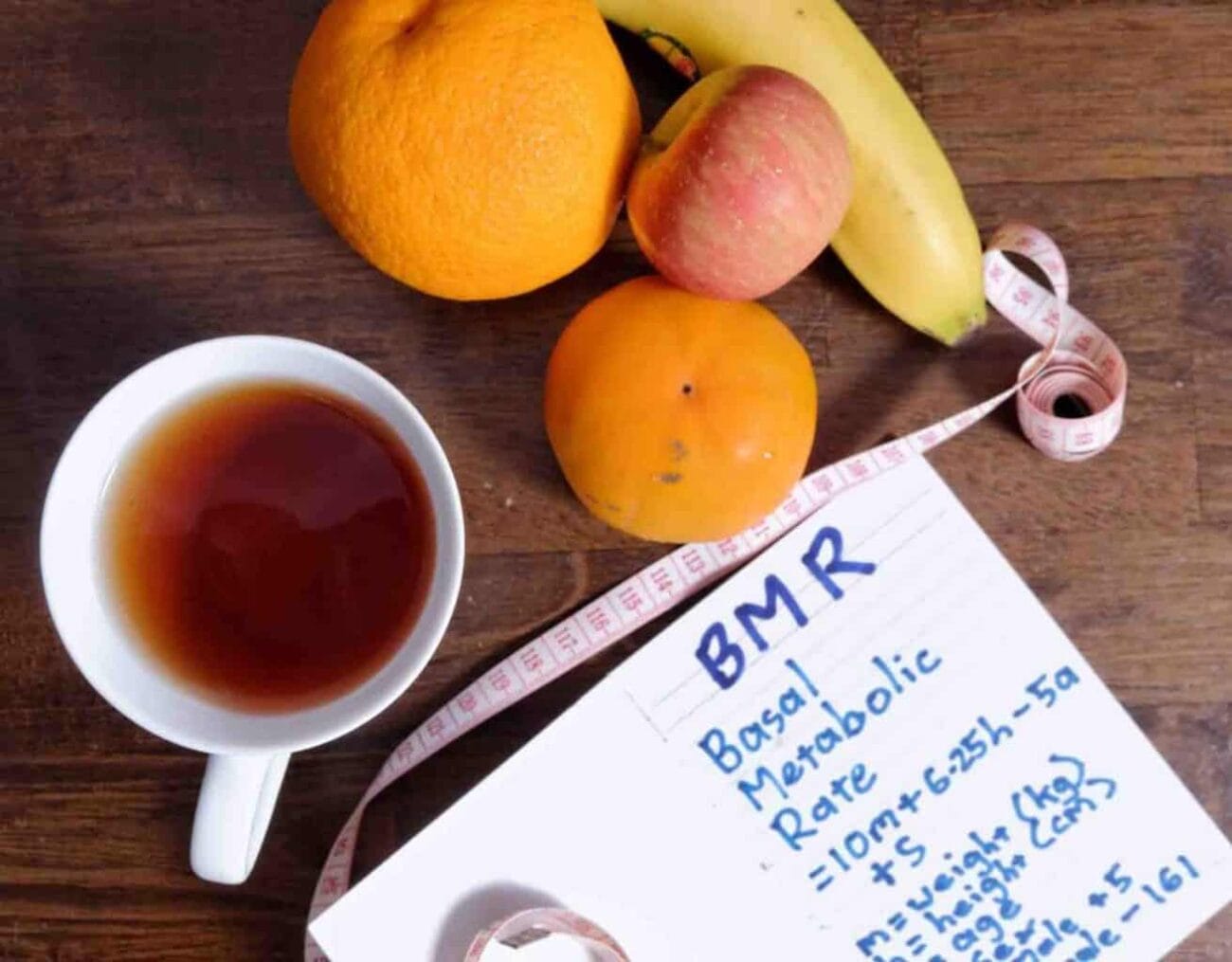
The four factors that have the greatest influence on your metabolism
I'm sure you've heard the word metabolism, probably too many times, but do you know what it consists of?
You don't need a degree in biochemistry or nutrition, but by knowing the four factors that have the greatest impact on metabolism, you can use that to your advantage.
But first of all, it's important to know, what is a calorie?
Calorie is a unit of measurement, more precisely, it is the amount of heat required to raise 1 gram of water by 1º C.
Everyone has different calorie needs, so there is no global measure.
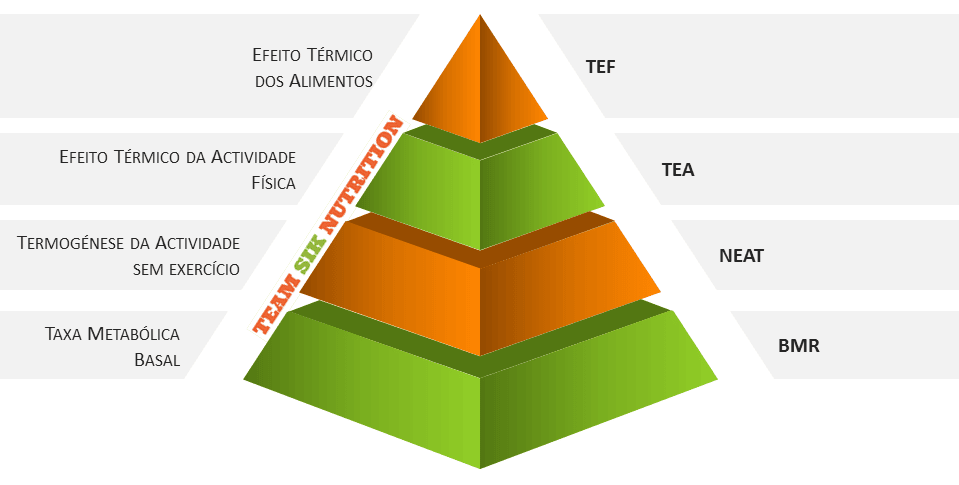
Pyramid of metabolism
The pyramid is composed of:
- BMR – Basal Metabolic Rate
- NEAT (+NEPA) – Non-exercise activity thermogenesis
- TEA – Thermal effect of physical activity
- TEF – Thermal effect of food
Basal Metabolic Rate – BMR
BMR (Basal Metabolic Rate) is the number of calories an individual burns daily at rest, just enough to breathe, reason and survive.
If we have to give a weight to this pyramid factor, it is about 60% of our daily caloric expenditure.
This value is directly associated with body weight, body composition, gender, age and genetics.
Inevitably, generally speaking, a larger body has a higher BMR.
Generally speaking, this is why women have lower calorie needs than men.

Non-exercise activity thermogenesis – NEAT
NEAT (Non-Exercise Activity Expenditure) is the number of calories burned to keep us stable, whether by typing on Facebook or doing other activities that are not directly related to physical exercise.
If we include NEPA (Non effort physical activity) in this category, it is possible to consider activities such as walking the dog, cleaning the house, etc.
It should be noted that this is highly variable, both from day to day and from person to person.

Thermal effect of physical activity – TEA
TEA (Thermogenic Effect of Activity) is the number of calories burned during exercise.
Typically, and based on our case, these are calories lost during cardiovascular training sessions or weight training.
The amount of energy expended in TEA is clearly dependent on the duration and intensity of training.
Thermic effect of food – TEF
It may come as a surprise to some, but yes, we also burn calories while eating.
Digestion is an active metabolic process.
Who has never felt hot or sweaty after a large meal? Especially after large amounts of protein.
This TEF (Thermogenic Effect of Food) factor represents approximately 5-10% of our daily caloric expenditure.
Find some more information about this phenomenon here.
Given the above, let us now consider all the variables.
Energy consumed = BMR + NEAT + TEA + TEF
There are people who tend to minimize the accounts, with the theory that the law of thermodynamics is simple, just subtract the calories ingested from the calories expended.
As you can see, predicting our calorie expenditure is a more complex process than we are often led to believe.
Why does basal metabolism differ between individuals?
Each person burns a certain number of calories per day, this value being made up of the basal metabolic rate (BMR), thermic effect of physical activity (TEA), non-exercise activity thermogenesis (NEAT) and thermic effect of food (TEF).
As such, there is no point in trying to find the perfect formula or magic calculator to find your maintenance calorie count.
The most efficient way to do this is to monitor, as best as possible, your NEAT, TEA and estimated BMR, and also your total calories, in order to find approximately your maintenance calories.
To make it easier to understand the immeasurable difference, a person with an extremely active job can burn up to 500 more calories per day than a person with a sedentary job.
And now, what to do with this information?
Basically, by understanding how your body works, you can monitor what happens daily in more detail.
Typically, the people who pay the most attention to these details are people in the process of losing fat.
For those people, here are some tips that may be useful.
- BMR will inevitably fall.
It is the body's way of defending itself against caloric restriction.
- NEAT will tend to decrease, due to caloric restriction and extra fatigue, making it normal to rest more.
Here the idea is to get up as many times as possible, consuming the greatest number of calories, without adding to the fatigue that already exists due to ASD.
- People tend to focus on increasing their calorie deficit by increasing TEA in the form of cardiovascular exercise, or metabolic exercise/circuits.
This may be a bad idea, considering that if there is no monitoring and management of fatigue, the tendency may be to lower BMR and NEAT.
- To ensure the most efficient TEF, always focus on plenty of protein.
In addition to being extremely important for maintaining muscle mass at this stage, it contributes to higher TEF values.
[toggle title=”Bibliography” state=”close” ]Energy balance
Metabolism[/toggle]
Article written by Team Sik Nutrition
[author image=”https://ginasiovirtual.com/wp-content/uploads/2016/01/logo-sik.jpg” ]Team Sik Nutrition is a recently formed group of people passionate about the world of fitness. The team’s focus is to guide, educate and motivate those interested in achieving their health and fitness/performance goals. All of this information is based on scientific facts and the experience of the team members.
The CEO of Team Sik Nutrition is João Gonçalves. He is an amateur powerlifter, passionate about fitness and writing articles.
[/author]